A New Concept of What a Playground Should Strive to be.
“Children need the freedom and time to play. Play is not a luxury. Play is a necessity.”
— Kay Redfield Jamison
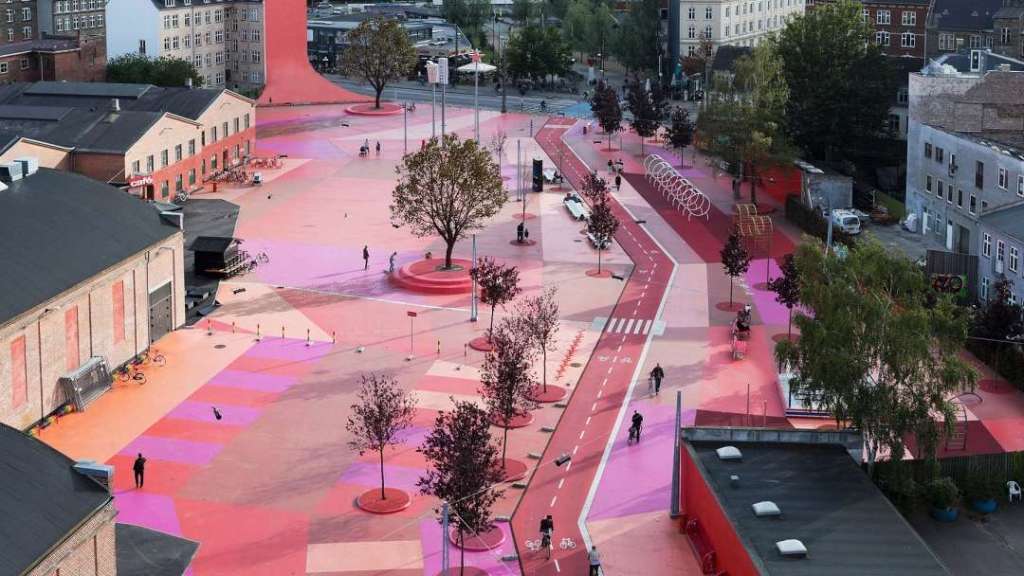
Superkillen is a playground located in Nørrebro; a municipality outside of the city center of Copenhagen. While it might not have lavish play equipment, the open space, and lively atmosphere help make this location a prime spot for family and children’s leisure activities. Based on conversations with locals, this park is also a hotspot for children to gather after the end of the school day. Unlike some other parks where the space is directly oriented toward the playground equipment; the playground equipment at Superkillen seems to be the less emphasized element. Rather, the painted ground and wall art are what catch your attention the most. The park’s open space is centered in the middle, and the small amount of play equipment that is there is can be found along the sides of the park.
One of the most fascinating elements of this park is the way that the simple white lines(or in the front of the park: the reg-hued geometric blocks) painted on the blacktop shape social behavior and play. Kids and adults alike can be seen walking, running, biking, and skateboarding all throughout the space.
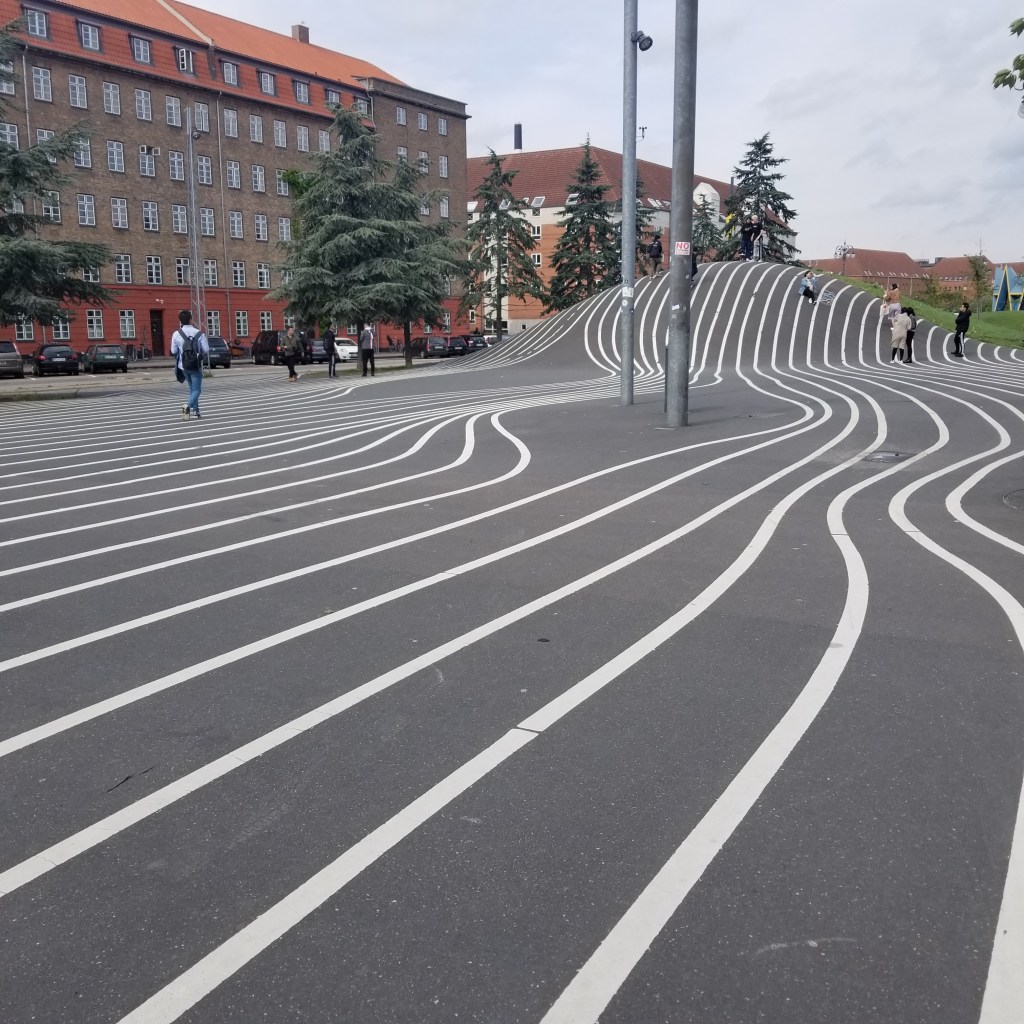
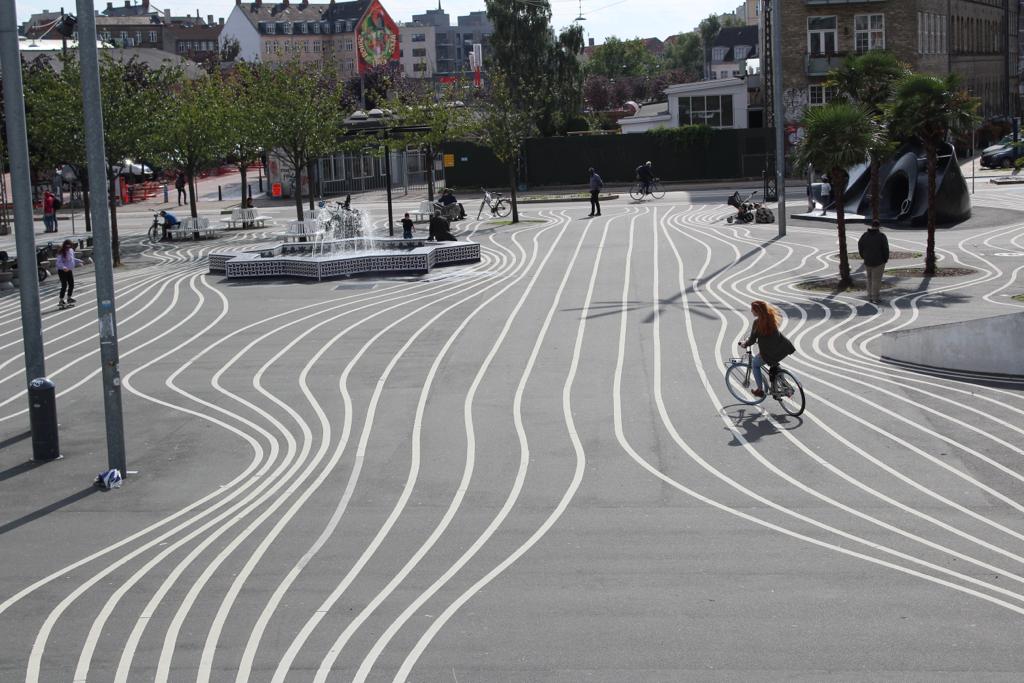
A park such as this opens a discussion of what types of environment are productive to play(or rather different types of play). The 2-D drawn shapes promote imagination in a different way then 3-D objects do. 3-D play equipment engages the sense of touch( and taste depending on how young the child is), and gives children something physical to guide their experience. 2-D types of stimulus engage the sense of sight, but also require the child to use their imagination to guide them in how they use the place. The child might decide that they cannot touch the white lines, or that they must jump in order to get from block to block. The child gets to guide and create what the space means to them, which is very beneficial to instilling skills of creativity and imagination in children.
A concern for the future of this park is that it has been becoming a popular tourist location. While visiting, many people were found on top of the hill taking photographs. This is not a problem outright, but when tourists crowd spaces like this it takes away from the people who would have normally made use of these places. In this case, it would be largely children. There were a group of boys at the bottom of the hill who quite evidently wanted to make use of this space, but couldn’t because of the amateur photoshoots taking place. Overall, however, the space seemed to still be largely used by children, families, and the local community so tourism may be only minorly affecting the way that this area is used.
Author: Caitlyn Marshall
Work Cited: (1st image) Baan, I. (n.d.). Superkilen – Dansk Arkitektur Center. Retrieved November 14, 2019, from https://dac.dk/viden/arkitektur/superkilen/.
 Copenhagen's Family Friendly Places